
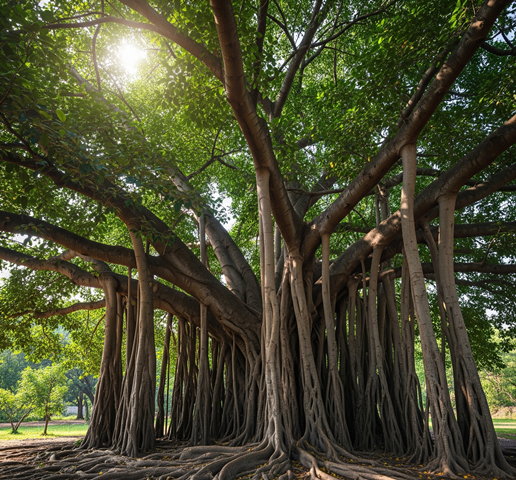
The Nyagrodha /Banyan tree (Ficus benghalensis) holds deep roots in Indian mythology and Ayurveda. Worshipped as sacred and symbolizing eternal life, it appears in scriptures and rituals. Beyond its spiritual role, it offers powerful healing benefits. Let’s explore Nyagrodha in ayurveda sanatan & Scripture-Medicinal Value of banyan tree, its rich legacy in both tradition and medicine.
Nyagrodha in ayurveda sanatan & Scripture
Ramayana
As Rama, Sita, and Lakshmana reached Prayaga during their journey, Sage Bharadvaja took them to a special banyan tree called Syama Nyagrodha. At his request, Sita offered her respects to the tree — she bowed, walked around it (performed parikrama), and prayed. She asked for Rama’s success in keeping his vows and for blessings on her mothers-in-law. This tree is considered a sacred tree (caitya-vṛkṣa) and is worshipped like a shrine. It represents good fortune and spiritual protection. Many believe that siddhas (enlightened beings) live near or in such trees.
Mahabharata
First, during the time when the universe was being destroyed, sage Markandeya saw a Divine Baby (Lord Vishnu) lying calmly on a banyan leaf, floating in the cosmic ocean. This powerful image shows the banyan tree as a symbol of cosmic support and protection.
Second, the story of Akshayavata in Gaya shows the tree’s importance in ancestral rituals. People who perform shraddha (rituals for ancestors) under this tree gain spiritual merit and help their ancestors attain peace and freedom from suffering.
Mahāvaṇija-Jātaka & Dummedha-Jātaka
In the Mahāvaṇija-Jātaka, there is a magical banyan tree that gives water, food, maidens, and treasures from its branches—just like a Kalpavṛkṣa, the wish-fulfilling tree.
In the Dummedha-Jātaka, people offer animal sacrifices to the spirit of a tree called Vata-Yakṣinī, hoping to get children, respect, and wealth. This shows the early belief that powerful spirits lived inside trees, and people worshipped them to fulfill their desires.
Satyavan Savitri & Bhagavata Purana
In the story of Savitri and Satyavan, the Banyan marks Satyavan’s death and rebirth. It stands for the resilience of life, devotion, and spiritual strength. Meanwhile, the Bhagavata Purana portrays the tree’s seed as containing Karnika/Bīja, a presiding deity of the fixed forms. This seed metaphor becomes a powerful image of the Supreme Being hidden within all creation.
The Garuda Purana goes further. It prescribes rituals at a Banyan in Prayaga: offering pindas to free ancestral spirits. Feeding one Brahmin here is said to equal feeding a million elsewhere. Performing shraddha at the tree’s base grants liberation and merit for countless generations.
Cultural Echoes & Symbolism
In Buddhism, the Banyan serves as a place for reflection, offerings, and pivotal encounters. In Hinduism, it stands for refuge, wisdom, stability, and spiritual liberation. It connects laypeople to deities like Vishnu and Shiva. It also weaves together ideas of cosmic unity and eternal life.
Sources: Bhagavata Purana, Garuda Purana, Dummedha Jataka, and various other scriptures and books.
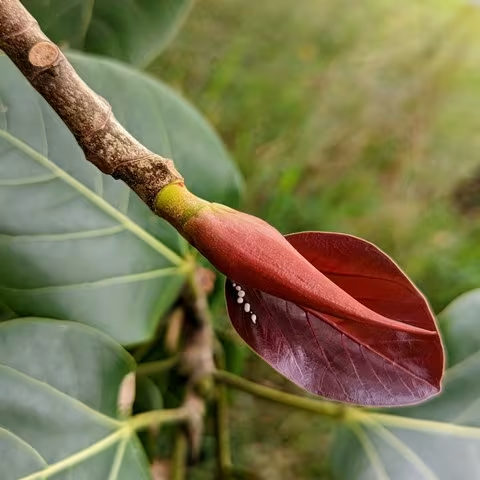
Ayurvedic Uses & Phytochemistry
In Ayurveda, the Banyan tree called Vata or Vada finds wide use. Practitioners treat diarrhea, dysentery, and skin disorders using extracts of its leaves, bark, and roots.
Here’s a breakdown of its active components:
- Aerial roots: Contain phytosterols
- Leaves: Contain triterpenes like Friedelin and β‑sitosterol
- Bark: Offers hypoglycemic glycosides including bengalinoside and flavonoid glycosides such as leucocyanidin
- Heartwood: Rich in tatraxasterol esters and liglic acid (EasyAyurveda)
Health Benefits From Research
Modern studies support many traditional claims. Ficus benghalensis demonstrates:
- Antidiabetic: Extracts lower blood glucose in animals and inhibit sugar enzymes.
- Antibacterial & Anthelmintic: Active against bacteria and parasites.
- Analgesic: Reduces pain in animal models.
- Anti-inflammatory & Antioxidant: Thanks to flavonoids, it calms inflammation and fights free radicals.
- Anticancer: Flavonoid-rich extracts trigger cancer cell death in vitro.
- Supports circulation: Shows anticoagulant, platelet-aggregation, and hypotensive benefits (PMC).
Final Thoughts on Nyagrodha in ayurveda sanatan
The Banyan tree emerges as more than a natural wonder. It is a spiritual icon, a cultural beacon, and a pharmacological ally. Known as Nyagrodha in Ayurveda Sanatan, it holds a revered place in Indian tradition. From its portrayal in ancient epics to its healing role in Ayurveda and its scientific validation today, Ficus benghalensis stands as a living bridge between myth and medicine.
Disclaimer:
The information provided in this article is for educational and informational purposes only. It is not intended to diagnose, treat, cure, or prevent any disease. Always consult with a qualified healthcare professional before starting any new herbal or health regimen. While traditional knowledge and scientific research support many of the benefits mentioned, individual results may vary. We encourage informed choices and responsible wellness practices.


